May Lee Post Layoff Antarctica Job: Former HP Employee’s New Career at 59
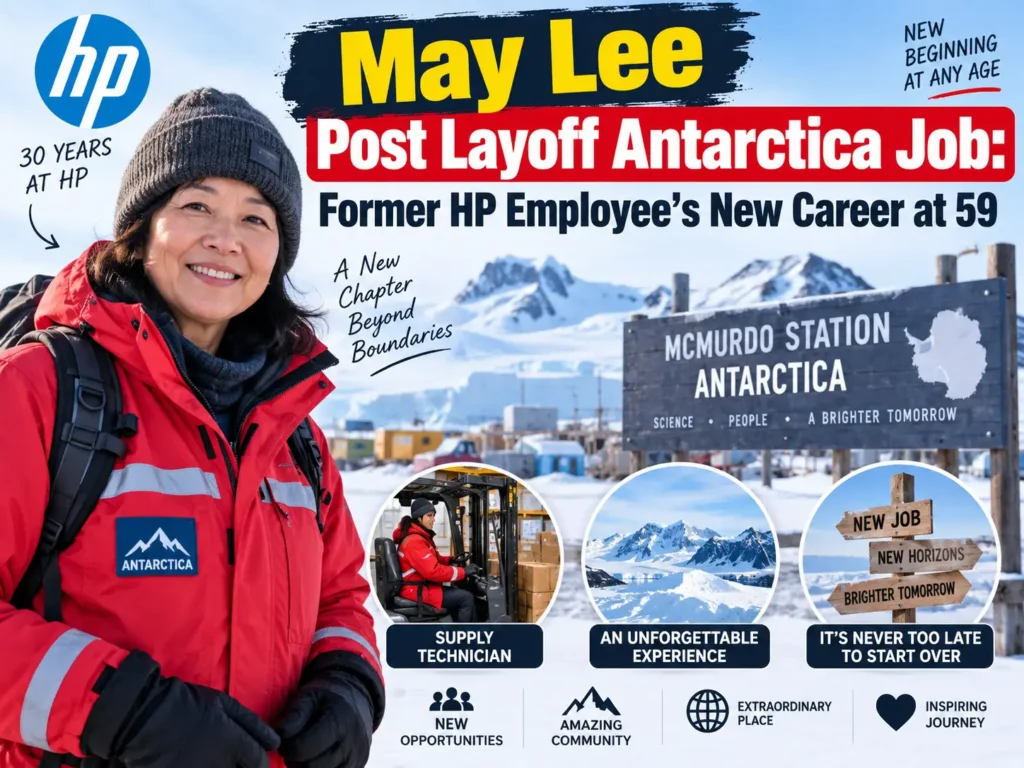
May Lee’s Post-Layoff Antarctica Job: How a 59-Year-Old Former HP Employee Started Over at McMurdo
May Lee’s career took an unexpected turn after she was laid off from Hewlett-Packard following about three decades with the company. Instead of remaining in the technology sector, the 59-year-old explored an interest she had developed during two previous trips to Antarctica and eventually secured seasonal work at McMurdo Station as a supply technician with Amentum. Her story has attracted attention because it shows how a long corporate career can give way to a very different kind of working life.
Lee’s experience was first detailed by Business Insider in an as-told-to essay published on September 11, 2026. Recent reports from India Today, The Indian Express and The Economic Times have since highlighted the unusual career transition.
May Lee spent around 30 years at HP
Lee joined HP in 1987 as a software engineering intern. According to her account published by Business Insider, she had expected the company to be a long-term home for her career and had planned to continue working there for several more years. Over time, she moved through different roles and ultimately worked as a marketing and communications manager.
The end of that career came with a layoff. Lee said there had been warning signs, including a hiring freeze and a temporary reduction in working hours, but she still described the decision as a surprise. The layoff left her disappointed because she had imagined remaining with HP until much closer to retirement.
The job search did not produce the result she expected
After leaving HP, Lee entered what she described as an intense job search. She applied to technology companies and relied on a broad professional network and referrals. Despite those efforts, she said she was unable to secure another position.
A former HP colleague then encouraged her to look beyond the technology industry and consider areas she genuinely enjoyed. That advice became important because Lee had already developed a strong personal interest in Antarctica.
Two trips to Antarctica helped shape her next move
Lee had visited Antarctica twice as a tourist before losing her job. She said she enjoyed those trips and had never seriously considered the possibility of working there until she began researching alternatives after the layoff. Her search revealed that employment opportunities do exist at Antarctic research stations and support facilities.
That discovery eventually led her to apply for a seasonal position. The process was not presented as an easy route into Antarctic employment. Lee said it involved a lengthy application process, an extensive background check and physical qualification requirements. She was ultimately hired by Amentum as a supply technician.
What May Lee did at McMurdo Station
The supply technician role was a major change from the desk-based technology work Lee had performed for much of her career. In Antarctica, she worked in warehouse logistics and was responsible for handling supplies and cargo. Her account included operating a forklift, checking quantities against database records and performing physical work such as lifting boxes outdoors.
Amentum’s current job description for a Supply Technician at McMurdo Station provides additional context about the role. Duties include receiving and documenting materials, maintaining inventory records, investigating discrepancies, using enterprise resource planning systems and assisting with transportation and logistics activities. The position can also involve forklift training, runway support and work outdoors in changing and extreme temperatures.
The official listing also shows that Antarctic supply work involves more than warehouse administration. Applicants can be expected to handle physical tasks, work extended periods in Antarctica and complete medical, dental, drug-screening and background-check requirements. The current listing states that U.S. citizenship is required for facility credentials and authorization at that work location.
McMurdo is the central logistics hub for U.S. Antarctic research
McMurdo Station is not simply an isolated workplace. According to the U.S. National Science Foundation, McMurdo is the largest U.S. year-round station and the largest station on the Antarctic continent. It serves as a central logistical hub for the U.S. Antarctic Program and supports research carried out across the continent, including operations connected with the South Pole Station.
That logistical role helps explain why support jobs such as supply, transportation, inventory, communications, maintenance and food services are necessary alongside scientific work.
The official U.S. Antarctic Program jobs and opportunities page lists support positions with organizations such as Amentum, Leidos and other contractors. The roles can range from logistics and transportation to information technology, communications, maintenance and station services.
The job paid less, but Lee valued the experience
One of the clearest trade-offs in Lee’s story was financial. She said the Antarctic position paid substantially less than her former technology-sector salary. Her circumstances were different from someone who urgently needs a high income, however, because she had already paid off her home and had built a financial foundation that gave her more flexibility in choosing what to do next.
For Lee, the value of the opportunity was not limited to compensation. The work placed her in a remote community where daily life was very different from a conventional corporate environment.
Life in Antarctica offered a different kind of community
Lee said one of the unexpected positives was the social atmosphere at McMurdo. With limited internet access and fewer opportunities to remain constantly connected to phones and digital services, she found that people spent more time talking with one another, particularly during meals.
She also participated in station activities and volunteered as a DJ for a weekly 1980s-themed radio show. Those experiences became part of what made the Antarctic assignment feel more like a community than simply a temporary job.
The living environment itself is demanding. NSF describes McMurdo as a coastal Antarctic station surrounded by sea ice for much of the year, with an annual mean temperature of about -18°C and recorded temperatures ranging from -50°C to +8°C.
May Lee plans to return to Antarctica
Rather than treating the experience as a one-time experiment, Lee said she wanted to continue working in Antarctica. According to Business Insider, she planned to return to McMurdo in the fall in a different role as a broadcast engineer.
That next step also highlights an important part of her story: her move to Antarctica did not mean abandoning technology completely. Her new role would draw on technical skills while keeping her connected to the unusual environment she had come to value.
What the May Lee story says about career changes
The broader lesson from Lee’s experience is not that everyone leaving the technology industry should seek work in Antarctica. Her circumstances were highly specific. She had previous Antarctic travel experience, a long professional background, an established financial base and the willingness to pursue a highly unusual seasonal opportunity.
Her story does, however, demonstrate how career changes can emerge from unexpected circumstances. A layoff that initially appeared to close one chapter eventually pushed Lee to explore an interest she had previously treated as a travel experience rather than a career possibility.
It also illustrates the difference between an unusual job story and a conventional job-market opportunity. Antarctic positions can be competitive, seasonal and subject to strict operational, medical and eligibility requirements. Current official listings should therefore be consulted before anyone considers applying.
For readers interested in the business and logistics side of unusual workplaces, Newsgrow.club also covers developments involving global cargo and logistics operations. The site’s Business category is the most relevant section for this story because it connects employment, business operations and logistics.
Are there really jobs in Antarctica?
Yes. The U.S. Antarctic Program officially lists employment opportunities supporting scientific operations in Antarctica. These include positions in logistics, transportation, information technology, communications, maintenance, food services and other support functions. Not every job listed on the USAP site necessarily involves deployment to Antarctica, and applicants should check the details of each position.
Was May Lee’s Antarctica job a permanent position?
No. Lee’s position was seasonal. Business Insider reported that the majority of jobs in Antarctica are seasonal and that she intended to return for another role after completing her initial assignment.
Did May Lee continue working in technology?
Her Antarctic role was significantly different from her previous corporate career, but her planned return as a broadcast engineer shows that her technical background remained relevant. Her career path demonstrates that changing industries does not necessarily mean abandoning previous skills.
Is working in Antarctica easy to get?
No. Lee described a competitive and lengthy selection process. Current Amentum listings also show background checks, physical requirements, medical and dental examinations and other eligibility conditions for some Antarctic positions. Requirements differ according to the employer and role.
Conclusion
May Lee’s post-layoff Antarctica job story stands out because of the scale of the career change. After roughly 30 years at HP, a difficult job search led her to reconsider what she wanted from work. Her decision to pursue an opportunity at McMurdo Station turned a corporate setback into a very different professional chapter.
Her experience also provides a realistic picture of Antarctic employment: the work can be physically demanding, positions may be seasonal, selection can be competitive and the financial trade-offs can be significant. At the same time, Lee found a community and environment she valued enough to want to return. Her story is ultimately about career reinvention, but it is also a reminder that unusual opportunities often come with equally unusual requirements.