Mitsubishi Pajero Montero Rendering Shows a Feisty Widebody Look
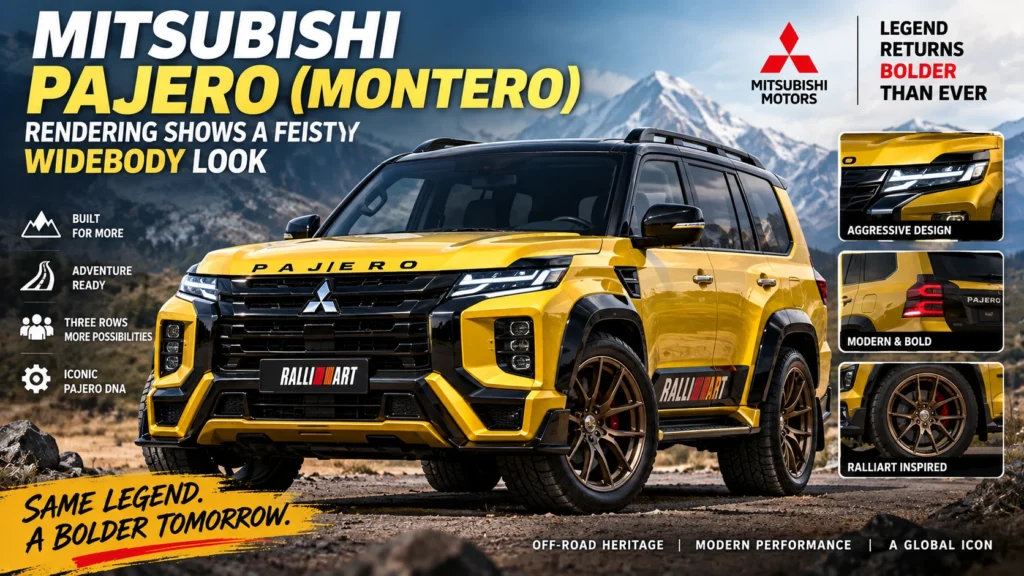
All-New Mitsubishi Pajero (Montero) Rendering Shows a Feisty Widebody Look for America
The all-new Mitsubishi Pajero has officially returned for a new generation, and an unofficial CGI rendering is now imagining how the rugged SUV could look with a much more aggressive street-focused makeover. Created by virtual automotive artist Nikita Chuicko, better known online as kelsonik, the rendering gives the new Pajero a bright yellow finish, contrasting black trim, wider bodywork and bronze aftermarket-style wheels.
The important distinction is that the yellow widebody vehicle is not an official Mitsubishi model. It is a digital design created by an independent artist. Mitsubishi, however, has officially unveiled the production-specification all-new Pajero, making the rendering particularly interesting because it builds on a real vehicle rather than a purely speculative nameplate.
Mitsubishi Has Officially Revived the Pajero
Mitsubishi Motors unveiled the fully redesigned Pajero on September 2, 2026, describing it as a new-generation flagship cross-country SUV. The new model marks the return of one of the company’s best-known SUV names after the previous generation was discontinued in overseas markets.
According to Mitsubishi, the new Pajero will initially be produced in Thailand. The company plans to launch it first in Thailand, followed by Japan and Australia during fiscal 2026, with further expansion from fiscal 2027 into markets including ASEAN countries, Latin America and the Middle East.
The Pajero name has a long history. Mitsubishi says the model was introduced in 1982 and became one of its most recognizable vehicles, with production across four generations exceeding 3.29 million units and a presence in more than 170 countries and regions.
For readers following the wider business side of the automotive industry, Newsgrow.club also covers developments affecting major companies and global industries in its Business section.
What Does the New Pajero Offer?
The production Mitsubishi Pajero is designed to remain a genuine off-road SUV rather than simply becoming another road-oriented crossover. The company says the model uses a rigid ladder frame, sophisticated suspension hardware and Mitsubishi’s Super Select 4WD-II system.
The SUV also introduces Super-All Wheel Control (S-AWC), Mitsubishi’s integrated vehicle-dynamics system designed to coordinate acceleration, cornering and braking. The four-wheel-drive system provides several operating modes, including 2H, 4H, 4HLc and 4LLc for different driving conditions.
Mitsubishi has also equipped the vehicle with seven selectable drive modes: Normal, Eco, Gravel, Snow, Mud, Sand and Rock. That combination suggests the new Pajero is intended to retain the serious all-terrain character associated with the nameplate.
Ground Clearance and Off-Road Numbers
The new Pajero’s dimensions reinforce its positioning as a substantial adventure SUV. Mitsubishi lists a length of 4,920 mm, a width of 1,925 mm and a height of 1,910 mm, with a wheelbase of 2,870 mm.
Ground clearance is rated at 230 mm on vehicles equipped with 20-inch tires. The official approach angle is 30.4 degrees, while the ramp breakover angle is 22.6 degrees and the departure angle is 25.8 degrees.
Those numbers matter because they show why the Pajero can appeal to buyers who want more than a stylish family SUV. The combination of high ground clearance, low-range four-wheel drive and a ladder-frame platform gives the vehicle a mechanical foundation aimed at demanding terrain.
The New Pajero Also Has Three Rows of Seats
One of the biggest changes is that the latest Pajero combines its off-road credentials with a three-row, seven-seat interior. Mitsubishi says the cabin has been designed to provide usable space across all three rows, including improved access to the third row.
The second row has a 150 mm sliding range, while the third row has been designed with additional attention to headroom and foot space. This gives the Pajero a broader role as a family vehicle while maintaining its adventure-focused identity.
The cabin also features a large horizontal display arrangement, including up to two 14.3-inch screens depending on specification. Mitsubishi has reinterpreted the traditional Pajero triple-gauge concept as a digital Multi Meter capable of displaying information such as altitude, compass heading, temperature and vehicle pitch and roll.
A Diesel Engine Keeps the Pajero’s Traditional Character
The all-new Pajero is equipped with a specially developed 2.4-liter clean-diesel engine with a variable-geometry turbocharger. Mitsubishi quotes maximum torque of up to 480 Nm, with some specifications listed at 470 Nm.
The engine is paired with a newly developed eight-speed automatic transmission. Mitsubishi says the combination is intended to provide strong response both from a standstill and at higher speeds while improving refinement and quietness.
This powertrain also fits the character of the new Pajero. Rather than abandoning the model’s traditional off-road identity in favor of a purely urban vehicle, Mitsubishi has retained a conventional four-wheel-drive architecture and diesel torque aimed at difficult terrain and long-distance travel.
What the Kelsonik Rendering Changes
The unofficial rendering takes a very different approach from Mitsubishi’s factory design. Instead of the production SUV’s premium adventure styling, kelsonik imagines a considerably more aggressive street-SUV interpretation.
The digital Pajero shown in the rendering wears a bright yellow exterior combined with extensive black elements. The treatment extends across the roof, pillars, mirrors and other trim areas, giving the SUV a dramatic two-tone appearance.
The biggest visual change is the widebody treatment. The rendering adds pronounced aerodynamic bodywork and wider fenders, creating a much more muscular stance. One of the imagined kits carries Ralliart branding, connecting the visual concept with Mitsubishi’s motorsport-oriented performance heritage.
Bronze Y-spoke wheels complete the fictional build. Together with the lowered, more aggressive appearance, the changes make the Pajero look less like a traditional off-road family SUV and more like a performance-oriented Japanese street machine.
Could This Be the Look of an American Montero?
This is where the distinction between fact and speculation becomes especially important.
The Pajero is known as the Montero in some markets, and Mitsubishi has confirmed plans for a phased international rollout. However, a North American version has not been officially announced in the September 2026 launch information from Mitsubishi.
The rendering therefore should not be interpreted as a preview of an upcoming U.S.-specification Montero. It is better understood as a design exercise showing what the real Pajero could look like if an enthusiast-oriented street version were created.
Even so, the idea is easy to understand. The U.S. market has a strong appetite for large adventure SUVs, and Mitsubishi already has the ingredients for a vehicle with authentic off-road credibility. Whether the company eventually develops a Montero for North America is a separate question that remains unanswered.
Why the Rendering Is Interesting
The timing makes this CGI design more relevant than many speculative car renders. The Pajero is no longer an unconfirmed future vehicle. Mitsubishi has actually revealed the fifth-generation model, including its architecture, powertrain, four-wheel-drive technology, dimensions and interior layout.
That means designers such as kelsonik can experiment with the styling of an existing production vehicle rather than guessing whether the nameplate will return at all.
For enthusiasts, the rendering also raises an interesting question: should Mitsubishi eventually offer a more aggressive Ralliart-inspired Pajero variant? The official SUV already has a strong off-road foundation, so a more performance-focused derivative could visually and mechanically build on that platform.
There is currently no official announcement that Mitsubishi is preparing the specific widebody model shown in the rendering. Any future Ralliart version would therefore remain speculation until Mitsubishi itself confirms one.
Official Pajero vs. CGI Rendering
| Feature | Official All-New Pajero | Kelsonik CGI Rendering |
|---|---|---|
| Vehicle status | Official Mitsubishi production model | Unofficial digital rendering |
| Body style | Premium three-row cross-country SUV | Aggressive widebody street-SUV concept |
| Exterior | Factory styling with upright proportions | Bright yellow with extensive black trim |
| Wheels | Factory-specification wheels depending on market | Bronze Y-spoke aftermarket-style wheels |
| Performance hardware | SS4-II, S-AWC and ladder frame | Visual customization only; mechanical changes are not official |
| Ralliart connection | No widebody Ralliart version announced with the launch | One imagined body kit carries Ralliart branding |
| U.S. availability | No North American launch confirmed in Mitsubishi’s announcement | Created partly as an imagined American-market look |
The Bigger Story for Mitsubishi
The importance of the new Pajero extends beyond styling. Mitsubishi is using the vehicle as a flagship for the next phase of its product strategy. The company describes it as the first model to bring its longer-term brand vision to life, combining off-road capability with greater refinement and premium positioning.
That balance could be important as global SUV buyers increasingly expect one vehicle to cover several roles: family transportation, long-distance touring and recreational off-road driving.
The Pajero’s three-row layout, modern technology and improved cabin refinement broaden its appeal, while the ladder frame, diesel engine and Super Select 4WD-II system protect the model’s traditional identity.
For Newsgrow.club readers interested in how major industries and manufacturers are evolving, our latest news and analysis provides additional coverage across technology, business and other major developments.
Sources and Further Reading
- Mitsubishi Motors: All-New Pajero official announcement
- Mitsubishi Motors: Pajero global return announcement
- Autoevolution: Kelsonik Mitsubishi Pajero rendering
Frequently Asked Questions
Is the new Mitsubishi Pajero real?
Yes. Mitsubishi Motors officially unveiled the fully redesigned Pajero on September 2, 2026. It is a production vehicle rather than a concept.
Is the yellow Mitsubishi Pajero in the article an official model?
No. The yellow widebody vehicle is an unofficial CGI rendering created by virtual automotive artist Nikita Chuicko, known as kelsonik.
Will the new Pajero come to the United States?
Mitsubishi has announced a phased global rollout, but its September 2026 official announcement does not confirm a U.S.-market Pajero or Montero. North American availability therefore remains unconfirmed.
What engine does the new Mitsubishi Pajero use?
The new Pajero uses a 2.4-liter clean-diesel engine with a variable-geometry turbocharger and up to 480 Nm of torque, paired with an eight-speed automatic transmission, depending on specification.
Does the new Pajero have four-wheel drive?
Yes. The new Pajero uses Mitsubishi’s Super Select 4WD-II system and also features Super-All Wheel Control for integrated vehicle-dynamics management.
Conclusion
The return of the Mitsubishi Pajero is already one of the Japanese automaker’s most important product developments of 2026. Mitsubishi has brought back the name with a genuine ladder-frame SUV, three rows of seating, diesel power and advanced four-wheel-drive technology.
The kelsonik rendering adds a different layer to the story. Its yellow paint, black contrast elements, widebody treatment, bronze wheels and Ralliart-inspired detailing are purely digital, but they demonstrate how much visual potential the new Pajero has for future enthusiast-focused interpretations.
For now, the production Pajero is confirmed, while the aggressive American-style Montero imagined by the rendering remains firmly in the realm of CGI. Whether Mitsubishi ever turns that idea into a real factory model will depend on the company’s future product plans and market decisions.