Hindi Diwas 2026: Why Hindi’s Reach Is Growing in India and Abroad
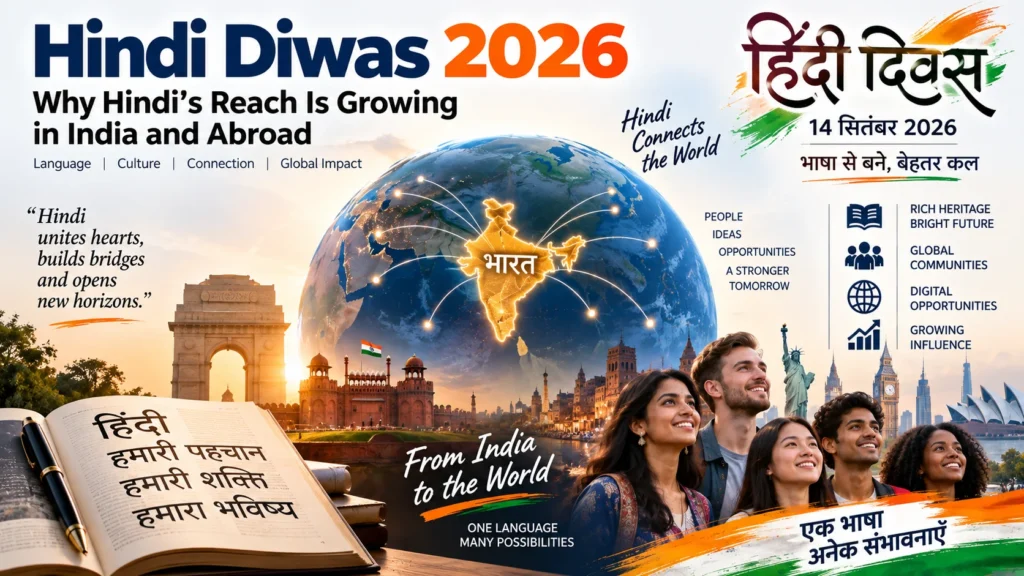
Hindi Diwas 2026: Why Hindi’s Reach Is Growing in India and Around the World
Hindi Diwas 2026 is being observed on September 14 with renewed attention on the language’s constitutional role, growing global presence and expanding influence through cinema, digital media and everyday communication. This year’s observance also comes as the Government of India prepares a two-day Hindi Diwas programme and the sixth Akhil Bharatiya Rajbhasha Sammelan in Mumbai on September 14 and 15.
Hindi occupies an important place in India’s public life, but its status is often described inaccurately. Under Article 343 of the Constitution, Hindi in the Devanagari script is the official language of the Union. India does not have a constitutionally designated national language. The distinction matters in a country where linguistic diversity is one of its defining characteristics.
Why Hindi Diwas Is Celebrated on September 14
Hindi Diwas commemorates the decision taken by the Constituent Assembly on September 14, 1949, when Hindi written in Devanagari script was adopted as the official language of the Union.
The constitutional framework was designed within the reality of a multilingual India. Article 343 provided for Hindi as the official language of the Union while also allowing English to continue for official purposes during the initial constitutional transition. Parliament later provided for the continued use of English through legislation.
The Government’s Department of Official Language continues to promote Hindi in official work while operating within the wider constitutional framework covering India’s many languages. The department’s official material confirms that Hindi Diwas is linked to the September 14, 1949 decision.
Readers can consult the Constitution of India and Article 343 for the precise constitutional wording.
Hindi Diwas 2026: Mumbai Hosts a Major Government Programme
The 2026 Hindi Diwas observance has a significant official programme attached to it. The Department of Official Language under the Ministry of Home Affairs has announced a Hindi Diwas समारोह and the sixth Akhil Bharatiya Rajbhasha Sammelan in Mumbai on September 14-15, 2026.
The announcement highlights how Hindi remains an active part of the Union government’s language policy more than seven decades after the Constituent Assembly’s decision. The department has also invited contributions for the souvenir associated with the 2026 Hindi Diwas and Rajbhasha conference.
The Department of Official Language announcement for the 2026 Mumbai programme provides the official event details.
Hindi Is Much Bigger Than Its Official-Language Role
Hindi’s importance cannot be measured only by the number of government offices that use it. It has become a major communication language across entertainment, television, publishing, advertising, social media and digital content.
A 2023 Ethnologue dataset cited in an Association of Indian Universities publication estimated around 609 million total Hindi speakers, including first- and second-language speakers. The figure is useful for understanding the scale of Hindi internationally, although language estimates vary depending on definitions and methodology.
That global footprint extends beyond India’s borders through migrant communities, cultural institutions, entertainment and online communication. Hindi films, music, television programmes and digital creators have helped the language travel well beyond the regions where it is traditionally spoken.
For wider national and international developments, readers can also follow the latest stories on the Newsgrow.club homepage.
The Difference Between a Language and a National Language Matters
One of the most persistent misconceptions surrounding Hindi is the statement that it is India’s “national language.” That description is not supported by the Constitution.
Hindi is the official language of the Union, not the constitutionally declared national language of India. The Constitution also recognises numerous other languages in the Eighth Schedule and protects India’s wider linguistic framework.
This distinction is particularly important on Hindi Diwas because celebrating Hindi does not require rejecting India’s other languages. Bengali, Tamil, Telugu, Marathi, Gujarati, Kannada, Malayalam, Punjabi, Assamese, Odia and many other languages are part of the country’s cultural and social fabric.
India’s experience shows that linguistic identity can be both deeply regional and strongly national at the same time. A person can be proud of Hindi while also valuing a mother tongue from another part of the country.
Why Hindi Can Act as a Cultural Bridge
Language often works differently from political boundaries. People may learn a language because of education, employment, entertainment, travel, commerce or simply curiosity. Hindi’s wide circulation gives it an ability to connect audiences who do not necessarily share the same mother tongue.
Indian cinema provides a clear example. Films produced in Telugu, Tamil, Malayalam and Kannada increasingly reach nationwide audiences through subtitles, dubbing and streaming platforms. Hindi versions of major South Indian productions have helped audiences discover actors, filmmakers and stories from outside the Hindi-speaking belt.
The reverse is also true. Regional-language audiences consume Hindi music, cinema, television and online content on a daily basis. Digital platforms have made this exchange faster and more accessible than earlier generations could have imagined.
AI and the Internet Are Changing How Indians Use Languages
The digital era could become one of the most important chapters in the history of Indian languages. Artificial intelligence, machine translation, speech recognition, automatic subtitles and multilingual search are making it easier for people to move between languages.
Someone who speaks Hindi can now consume content created originally in another Indian language with far less friction. Likewise, creators using regional languages can reach Hindi-speaking audiences without completely abandoning their original linguistic identity.
This development is especially significant for younger internet users. Social platforms encourage a constantly changing mixture of Hindi, English, regional languages, slang and newly created expressions. Instead of replacing one language with another, digital communication often produces hybrid forms that reflect how people actually speak.
Newsgrow.club also covers developments in the digital world through its Technology section, an area increasingly connected to the future of multilingual communication.
Hindi’s Global Growth Does Not Mean Other Languages Are Losing Their Importance
A healthy discussion about Hindi should avoid turning language into a competition. The strength of one Indian language does not automatically require the decline of another.
India’s linguistic diversity is one of its major cultural assets. Regional languages carry literature, oral traditions, music, historical memory and local knowledge that cannot simply be replaced by a single national linguistic model.
The more useful question in 2026 is therefore not whether Hindi should replace other languages. It is how Hindi and India’s regional languages can coexist and become easier to access through education, publishing, entertainment and technology.
What Hindi Diwas Means in the Digital Age
Hindi Diwas is often associated with government offices, language competitions and official programmes, but its relevance is now much broader.
For younger Indians, the language is increasingly encountered through smartphones, video platforms, podcasts, short-form content, online education, gaming communities and AI-powered tools. The future of Hindi may therefore be shaped as much by digital creators and technology companies as by traditional institutions.
The same principle applies to other Indian languages. Better translation and speech technologies can help people communicate across linguistic boundaries without forcing everyone into the same linguistic identity.
Frequently Asked Questions About Hindi Diwas 2026
When is Hindi Diwas celebrated in India?
Hindi Diwas is observed every year on September 14. The date commemorates the Constituent Assembly’s September 14, 1949 decision concerning Hindi as the official language of the Union.
Why is Hindi Diwas celebrated?
Hindi Diwas commemorates the adoption of Hindi in Devanagari script as the official language of the Union and promotes awareness and use of Hindi in public and cultural life.
Is Hindi India’s national language?
No. The Constitution does not designate Hindi as India’s national language. Article 343 specifies Hindi in Devanagari script as the official language of the Union.
How many people speak Hindi?
A 2023 Ethnologue estimate cited in an Association of Indian Universities publication put the total number of Hindi speakers at about 609 million, counting both first- and second-language speakers. Estimates can vary according to methodology.
Where is Hindi spoken outside India?
Hindi is used by Indian communities and learners in several countries, particularly where there are established Indian diasporas and cultural connections. Its international presence is also strengthened by films, television, music and online content.
Where will Hindi Diwas 2026 events be held?
The Department of Official Language has announced a Hindi Diwas programme and the sixth Akhil Bharatiya Rajbhasha Sammelan in Mumbai on September 14-15, 2026.
Conclusion
Hindi Diwas 2026 arrives at a time when language is being reshaped by migration, entertainment, social media and artificial intelligence. Hindi has a major constitutional and cultural role in India and a substantial international audience, but its future does not need to be built at the expense of India’s other languages.
The more promising path is multilingualism: Hindi can continue to expand while Tamil, Telugu, Bengali, Marathi, Malayalam, Kannada, Gujarati, Punjabi, Assamese, Odia and other Indian languages remain strong in their own communities and increasingly reach new audiences through technology.
That may be the most important lesson of Hindi Diwas in the digital age: languages are most powerful when they build bridges rather than barriers.
Authoritative Sources
- Government of India Department of Official Language — Hindi Diwas 2026 programme
- Constitution of India — Article 343 and the Official Language provisions
- Press Information Bureau — Hindi Day and its constitutional background
- Association of Indian Universities publication citing Ethnologue 2023 language-speaker estimates