How Many Job Vacancies Are There in Belgium? The Real Number (and What It Means for You)
How Many Job Vacancies Are There in Belgium?
Cutting through the statistics: The real data, regional breakdowns, and what the numbers mean for job seekers.
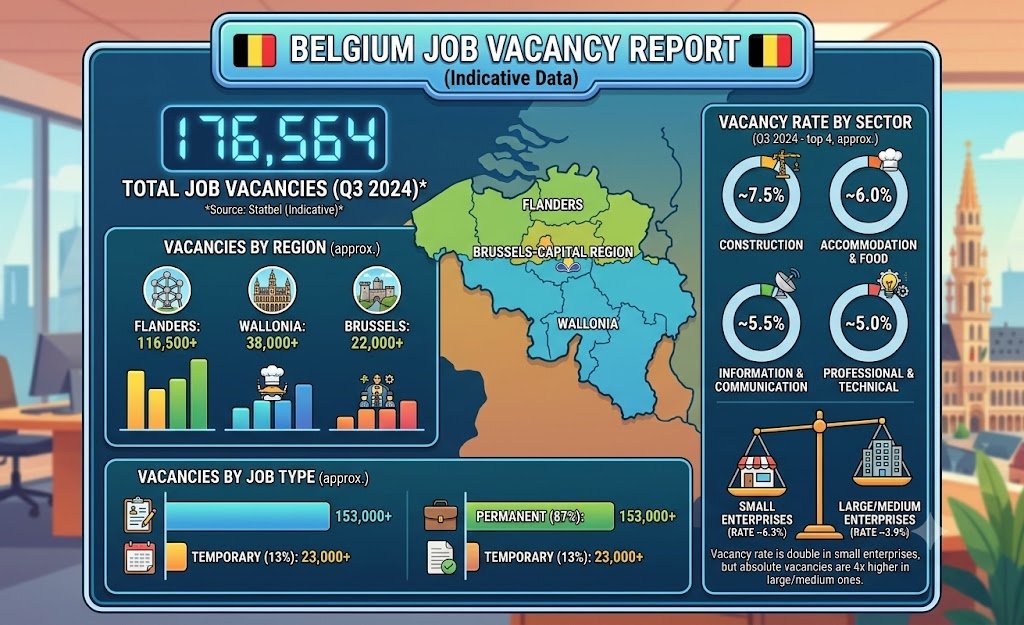
If you are researching job vacancies in Belgium, you may find conflicting reports ranging between 140,000 and 160,000 open positions, or a 3.5% vacancy rate. Understanding these numbers is essential to evaluating your employment prospects.
Official labor data reports approximately 140,000 to 146,000 open job vacancies with a 3.5% vacancy rate. This is among the highest rates in the European Union, significantly exceeding the EU average of 2.0%.
Verified Job Vacancy Statistics
Data provided by Statbel (the Belgian official statistics office) in collaboration with Eurostat outlines the current labor demand:
| Metric | Belgium Figures | Benchmark / Comparison |
|---|---|---|
| Total Job Vacancies | ~140,462 – 145,896 | Historical Peak: 213,822 (2022) |
| Job Vacancy Rate | 3.5% | EU Average: 2.0% | Eurozone: 2.2% |
| Flanders Share & Rate | ~66.8% of all vacancies | 4.31% Regional Vacancy Rate |
| Wallonia & Brussels Share | ~33.2% of all vacancies | Wallonia: 3.06% | Brussels: 3.31% |
The Skills Shortage Dilemma
Although total open vacancies have moderated from post-pandemic peaks, employers face severe recruitment hurdles due to qualified talent shortages.
According to research from industry analysts and ManpowerGroup, over 70% of Belgian employers encounter difficulties filling vacant roles due to a lack of specialized technical skills or required language proficiencies:
- Brussels Region: ~76% of employers report hiring difficulties.
- Flemish Region (Flanders): ~72% report hiring difficulties.
- Walloon Region (Wallonia): ~70% report hiring difficulties.
Highest In-Demand Sectors
Vacancies are concentrated in technical, operational, and public care industries across Belgium:
- Construction: Highest vacancy rate nationally at over 6.3% (Statbel).
- Engineering & Technical Services: Consistently named among the most challenging profiles to recruit by employers.
- Information Technology & Data: IT roles rank as a top recruitment challenge, with thousands of unfilled positions concentrated in major urban hubs.
- Public Services & Education: Non-profit and public service organizations face persistent operational hiring shortages.
- Healthcare & Logistics: Driven by population aging and regional supply-chain operations (mechanics, drivers, specialized healthcare).
Non-EU Applicants: Shortage Occupation Lists
For non-EU candidates, landing a position on a regional shortage occupation list bypasses lengthier labor market testing procedures, significantly expediting Single Permit approvals:
Regional Shortage Playbook Summary:
- Flanders: Focuses on healthcare professionals, nursing, engineering technicians, welders, and CNC operators via VDAB.
- Wallonia: Focuses on industrial electricians, maintenance managers, and mechanics via FOREM.
- Brussels: Heavy emphasis on cybersecurity, software engineering, and bilingual administrative roles via Actiris.
Actionable Job Search Recommendations
- Verify Shortage Status: Consult regional lists (VDAB, FOREM, Actiris) to verify if your title is listed for expedited permit processing.
- Target High-Volume Regions: Prioritize Flanders for the largest volume of open vacancies (~66.8% market share).
- Improve Language Competency: Develop intermediate-to-advanced proficiency in Dutch or French to gain a competitive advantage over single-language applicants.
- Focus on Technical Fields: Align applications with construction, engineering, IT, and healthcare sectors where labor demand remains resilient.